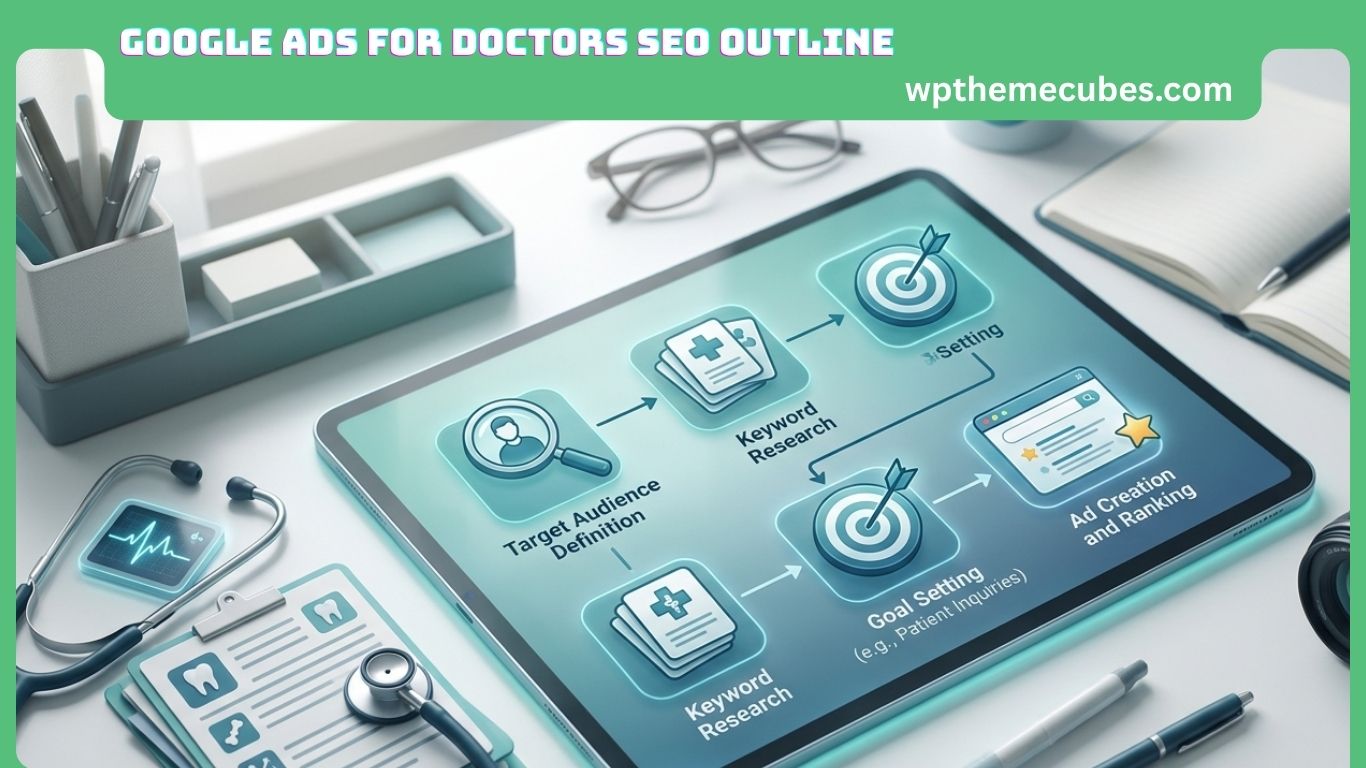
Google Ads for Doctors SEO Outline: Complete Guide
A Google Ads for doctors SEO outline combines paid advertising and SEO to help medical practices reach people searching for healthcare services. It includes keyword research, ad campaigns, landing page optimization, local SEO, useful content, and conversion tracking.
For doctors, a strong online presence should be clear, accurate, trustworthy, and easy to use. Google Ads can provide paid visibility, while SEO helps build long-term organic search visibility.
Together, these strategies can connect relevant searches with useful medical information, suitable landing pages, and actions such as calls or appointment requests.
What Is a Google Ads for Doctors SEO Outline?
A Google Ads for doctors SEO outline is a structured plan for using paid Google search advertising and organic SEO together to promote the online visibility of a medical practice.
It is not a specific Google product or official advertising program. Instead, the phrase describes a planning framework that can guide doctors and healthcare marketers through the major parts of search marketing.
A complete outline may include:
- Keyword research
- Search intent analysis
- Google Ads campaign structure
- Ad group organization
- Negative keywords
- Medical ad copy
- Landing page optimization
- Local SEO
- Google Business Profile optimization
- Medical content
- Technical SEO
- Conversion tracking
- Performance reporting
- Privacy considerations
- Advertising policy review
The purpose is to create a connection between search behavior and practice goals.
For example, a doctor may want more than website traffic. The actual goal could be to receive more qualified appointment requests from people looking for a specific service in a particular city.
That means the strategy should focus on relevant searches rather than traffic volume alone.
A good outline also helps prevent disconnected marketing activities. Keyword research should influence campaign organization, campaign data can inform content planning, and landing pages should match the intent behind the advertisements.

Why Google Ads and SEO Matter for Doctors
People often use Google when they need healthcare information or want to find a provider.
Some searches are educational. Others show that the person is actively looking for a doctor.
For example, “what causes back pain” is different from “orthopedic doctor near me.” The first search may indicate early research, while the second may show stronger provider-finding intent.
Google Ads can help eligible medical practices appear in paid search placements for relevant queries. SEO can help the website earn organic visibility for service pages, educational content, provider information, and local searches.
Using both methods can create several advantages.
SEO can support:
- Long-term organic visibility
- Educational resources
- Service pages
- Local relevance
- Provider authority
- Organic discovery
Google Ads can support:
- Paid search visibility
- Service-specific campaigns
- Geographic targeting
- Search-intent testing
- Appointment-focused traffic
- Measurable advertising campaigns
The two channels can also provide useful information for each other.
Also Read: Priority Infrastructure Plan: How Projects Are Ranked and Funded
For example, paid search data may reveal that people frequently search for a particular service using language that was not originally included in the practice’s SEO plan.
That information can help the practice evaluate whether its website has a useful page addressing that topic.
At the same time, SEO research may identify important services that deserve testing through paid advertising.
Google Ads for Doctors Keyword Research
Keyword research is a central part of a Google Ads for doctors SEO outline.
The objective is not to collect the largest possible list of keywords. The objective is to identify relevant searches that match the practice’s services, location, and patient needs.
Medical keywords can be organized into several groups.
Doctor-related searches may include:
- doctor near me
- physician near me
- primary care doctor
- family doctor
- local physician
Specialty searches may include:
- cardiologist near me
- dermatologist near me
- pediatrician near me
- orthopedic doctor near me
- neurologist near me
- ENT specialist near me
Service searches can include terms related to specific services actually offered by the practice.
Examples include:
- annual physical exam
- diabetes management
- allergy testing
- skin cancer screening
- sports injury treatment
- preventive care
Location-based searches can include:
- doctor in [city]
- [specialty] in [city]
- [service] near [city]
- [specialty] near me
- doctor near [ZIP code]
The keyword strategy should always reflect the real services of the practice.
A medical practice should not target a service simply because it has high search volume if that service is not provided.
Keyword research should also consider variations in how patients speak.
Medical professionals may use one clinical term while patients use a simpler phrase. A strong strategy can consider both, provided the resulting content remains medically accurate.
Search Intent for Medical Keywords
Search intent explains what a person wants when they enter a search query.
Understanding intent is important because the same medical topic can produce very different types of searches.
Informational intent occurs when someone wants to learn something.
Examples include:
- What is high blood pressure?
- What causes knee pain?
- What does a dermatologist treat?
- How often should adults get a physical?
These searches may be more appropriate for educational SEO content.
Commercial research intent occurs when a person is comparing providers or services.
Examples include:
- best cardiologist near me
- dermatology clinic near me
- pediatrician reviews
- orthopedic specialist consultation
These searches may require useful service and provider information rather than aggressive promotional language.
Appointment-focused searches show stronger action intent.
Examples include:
- book doctor appointment
- schedule physical exam
- cardiologist appointment
- dermatologist appointment near me
These searches can be valuable for relevant paid campaigns when the service and advertising setup are permitted.
Navigational intent occurs when someone is already looking for a particular organization or provider.
Examples include:
- [doctor name]
- [practice name]
- [clinic name] phone number
The important point is that not every keyword should lead to the same page.
An informational search may need an educational article. A service search may need a service page. A branded search may need the practice homepage or contact page.
How to Structure Google Ads Campaigns for Doctors
Campaign structure determines how a medical practice organizes keywords, advertisements, budgets, locations, and landing pages.
A small practice does not necessarily need a large number of campaigns.
A simple structure might begin with major service categories.
For example, a primary care practice could organize campaigns around:
Primary Care Services
Keywords can focus on relevant primary care searches, routine visits, annual exams, and related services.
Specialty Services
A multi-specialty practice could separate campaigns based on major specialties.
For example:
- Cardiology
- Dermatology
- Orthopedics
- Pediatrics
High-Priority Services
Some practices may have specific services that are especially important to their business goals.
These can receive dedicated campaigns when there is enough search demand to justify separate management.
The exact structure depends on practice size, location, budget, search volume, competition, and services.
Creating too many small campaigns can make performance harder to manage.
Creating one huge campaign for every medical service can also make it difficult to match advertisements and landing pages with specific search intent.
A practical structure should be detailed enough to provide control without becoming unnecessarily complicated.
Google Ads Keywords and Negative Keywords for Medical Practices
Keyword targeting should be monitored after campaigns go live.
A keyword that appears relevant may sometimes generate searches that have nothing to do with a doctor’s services.
Negative keywords can help reduce irrelevant traffic.
Depending on the practice, examples may include searches related to:
- Jobs
- Careers
- Training
- School
- Courses
- Salary
- Textbooks
- Free resources
These are examples only. The appropriate negative keyword list depends on actual search behavior.
Search-term reports can help identify queries that trigger advertisements.
For example, if a practice advertises a medical specialty but repeatedly receives searches from people looking for employment in that field, employment-related negative keywords may be useful.
Negative keywords should not be created blindly.
A practice should review the actual search context before excluding terms because some words can have different meanings.
Ongoing search-term review is therefore an important part of campaign management.
How to Write Effective Google Ads for Doctors
Medical ad copy should be clear, factual, and easy to understand.
A person seeing an advertisement should be able to understand what the practice offers without needing to decode complicated language.
Useful information may include:
- Medical specialty
- Service offered
- Location
- Provider information
- Appointment option
- Practice feature that can be supported by facts
Examples of simple ad messaging include:
- Primary Care Appointments
- Local Family Medicine
- Schedule an Office Visit
- Dermatology Services
- Convenient Local Care
- Request an Appointment
The wording should accurately represent the practice.
Medical advertisers should avoid unsupported promises or guaranteed outcomes.
Statements suggesting that a treatment will definitely produce a specific health result can create misleading expectations.
Google’s healthcare and medicines advertising policy includes restrictions for certain healthcare categories and may require certification or additional requirements for some services. Advertisers should review the current rules that apply to their service and location before launching campaigns.
An advertisement should also match the landing page.
If an advertisement promotes a particular service but the landing page does not mention that service clearly, the user experience becomes weaker.
Landing Page SEO for Doctors
Landing pages play a major role in connecting advertising with conversions.
A landing page is the page where someone arrives after clicking an advertisement or another marketing link.
A doctor does not necessarily need a separate page for every keyword variation.
Instead, pages can be built around meaningful services and search intent.
For example, several closely related searches about a specific medical specialty could lead to one comprehensive specialty page.
A useful medical landing page may include:
- Clear page title
- Service explanation
- Provider information
- Location
- Contact details
- Appointment options
- Relevant qualifications
- Insurance information where appropriate
- Frequently asked questions
- Clear next step
The page should answer the visitor’s main question quickly.
Mobile usability is also important.
Many healthcare searches take place on smartphones. If a landing page is difficult to read, slow to load, or confusing to navigate, the visitor may leave before contacting the practice.
The landing page should therefore serve both SEO and user experience goals.
Medical SEO Content for Doctor Websites
Medical SEO content should be created primarily to help users.
A doctor website can publish useful content around conditions, services, procedures, preventive care, and common patient questions.
Examples include:
- What a specific medical service involves
- When someone may need to see a specialist
- How to prepare for an appointment
- Common questions about a procedure
- General information about a health condition
- Preventive care topics
- Recovery and after-visit information
Content should not be created simply because a keyword has search volume.
A page should have a clear purpose.
Also Read: Provascin: Ingredients, Cardiovascular Support, and Safety
For example, if a practice creates an article about a health condition, the article should provide understandable information rather than repeating the same keyword throughout the page.
Medical content also benefits from clear authorship and review information.
Where appropriate, the website can identify the qualified professional who wrote or reviewed the content.
Content should also be reviewed when medical guidance, services, or practice information changes.
A page that was accurate several years ago may need updates today.
This is particularly important for healthcare content because patients may rely on the information when making decisions.
E-E-A-T for Doctors and Healthcare Websites
E-E-A-T means Experience, Expertise, Authoritativeness, and Trustworthiness.
These concepts are important when creating healthcare content because users need to know whether information is reliable.
A doctor’s website can demonstrate expertise through:
- Provider credentials
- Education
- Certifications
- Professional experience
- Areas of practice
- Author information
- Medical review processes
Trust can also come from transparency.
A website should make basic business information easy to find.
This can include:
- Practice name
- Address
- Phone number
- Office hours
- Provider information
- Services
- Appointment information
- Privacy information
A website should not attempt to create artificial authority.
For example, adding impressive-sounding claims that cannot be supported does not make a practice more trustworthy.
Instead, the website should communicate real qualifications and experience in a clear way.
Healthcare content should also avoid presenting general information as personalized medical advice.
Clear language can help users understand the difference between educational information and individual medical care.
Local SEO for Doctors and Medical Practices
Local SEO is especially important for doctors because many patients want healthcare providers within a convenient geographic area.
Local search terms often include words such as “near me,” city names, neighborhoods, and ZIP codes.
A local SEO strategy can include:
- Google Business Profile
- Accurate business information
- Location pages
- Service-area information
- Provider profiles
- Local citations
- Review management
- Local keyword research
- Mobile optimization
Location pages should provide real value.
A practice with several genuine locations may need separate location pages that explain each office.
However, creating dozens of nearly identical pages for places where the practice does not actually operate can create a poor user experience.
Local SEO should reflect the real geographic footprint of the medical practice.
The same principle applies to business information.
The practice’s name, address, phone number, and other important details should be accurate and consistent across major online platforms.
Google Business Profile for Doctors
Google Business Profile can help patients discover a medical practice through Google Search and Maps.
An accurate profile may provide important information such as:
- Practice name
- Address
- Phone number
- Website
- Hours
- Directions
- Reviews
The profile should represent the actual medical practice.
A practice should avoid filling the business name with extra keywords that are not part of the real business name.
For example, adding a long list of services to the official business name can make the profile look unnatural and may conflict with platform guidelines.
Doctors should also pay attention to reviews.
Reviews can influence how potential patients perceive a practice, but healthcare organizations should handle patient information carefully.
Responses to reviews should not reveal private patient information.
A public response should never accidentally confirm details about someone’s care, diagnosis, appointment, or treatment.
Technical SEO for Medical Websites
Technical SEO helps search engines discover, crawl, and understand website content.
For doctor websites, important technical areas include:
- HTTPS
- Mobile usability
- Page speed
- Crawlability
- Indexing
- XML sitemaps
- Canonical URLs
- Internal links
- Clean URL structures
- Image optimization
- Broken links
- Accessible navigation
A medical website should also be easy for patients to use.
The main navigation should make important information easy to find.
For example, a visitor should not have to search through multiple menus to locate:
- Doctors
- Services
- Locations
- Contact information
- Appointment options
Technical improvements should support the user rather than exist only for search engines.
Structured data can also help search engines understand certain information about an organization or local business. However, structured data does not guarantee that a specific rich result or search feature will appear.
Technical SEO should therefore be treated as one part of a larger search strategy.
Conversion Tracking for Google Ads and Doctor SEO
Conversion tracking helps a practice understand what happens after someone interacts with an advertisement or website.
Potential conversion actions include:
- Phone calls
- Appointment requests
- Contact forms
- Booking completions
- Consultation requests
- New-patient registrations
However, not every conversion has the same value.
For example, a website form submission may be counted as a lead, but the person may never schedule an appointment.
A more useful measurement system can distinguish between:
- Advertisement click
- Website visit
- Lead
- Qualified lead
- Appointment
- Completed visit
This gives the practice a better understanding of marketing performance.
Privacy is especially important when designing healthcare measurement.
Practices should carefully review what data is collected, where it goes, which vendors receive it, and whether the implementation is appropriate for the organization and the information involved.
Google’s advertising measurement tools and policies can change, so tracking setups should be reviewed regularly instead of relying on outdated implementation instructions.
Healthcare Advertising and Privacy Considerations
Healthcare marketing requires careful attention to privacy and advertising rules.
Google’s healthcare and medicines advertising policy contains restrictions for certain healthcare services, products, and practices. Some categories may require certification or other approval before advertising. The applicable requirements can depend on the service and geographic location.
A medical practice should therefore review current Google Ads policies before launching campaigns.
Privacy is another major consideration.
Healthcare websites may collect information that can be sensitive. A practice should understand what information its website forms, analytics tools, advertising systems, call tracking tools, cookies, and other technologies collect.
Important questions include:
- What information is being collected?
- Is health information involved?
- Which third parties receive information?
- Is the data necessary for the stated purpose?
- What privacy disclosures are required?
- Are appropriate agreements needed?
- Does the implementation meet applicable legal requirements?
HIPAA is especially relevant to covered healthcare entities and business associates, but whether a particular marketing technology or implementation creates a compliance issue depends on the facts.
Practices should seek qualified legal or compliance advice when necessary.
Privacy should not be treated as a technical afterthought.
A marketing campaign that produces excellent numbers but creates unnecessary privacy risks is not a strong healthcare marketing strategy.
How to Measure and Improve Google Ads for Doctors SEO
A Google Ads for doctors SEO strategy should be reviewed continuously.
Google Ads reporting can include metrics such as:
- Impressions
- Clicks
- Click-through rate
- Cost per click
- Conversion rate
- Cost per conversion
- Search terms
- Search impression share
SEO reporting can include:
- Organic impressions
- Organic clicks
- Organic traffic
- Search visibility
- Service-page performance
- Local visibility
- Engagement
- Appointment-related actions
However, rankings and traffic should not be the only measurements.
The real question is whether the marketing activity is bringing relevant people to the practice and helping them take appropriate next steps.
A practice can improve its strategy by regularly reviewing:
- Which keywords produce useful traffic
- Which advertisements generate qualified leads
- Which landing pages perform best
- Which searches are irrelevant
- Which services have growing demand
- Which SEO pages attract relevant visitors
- Which pages need better content
- Whether conversion tracking remains accurate
Optimization should be based on evidence rather than assumptions.
If a particular keyword receives many clicks but produces no useful inquiries, the practice may need to reconsider its targeting or landing page.
If an SEO page attracts highly relevant visitors but receives few appointment actions, the page may need clearer information or a more useful next step.
The goal is continuous improvement.
Also Read: Keibann: Complete Guide to Visual Workflow and Task Management
A strong Google Ads for doctors SEO outline therefore connects research, advertising, website content, local SEO, tracking, and analysis into one system.
Medical practices, the most effective approach is not simply to chase more clicks or higher rankings. It is to create a trustworthy online presence that helps people find relevant healthcare information and understand how to contact the appropriate medical practice.
FAQs About Google Ads for Doctors SEO Outline
Can a small medical practice use Google Ads and SEO at the same time?
Yes. A small practice can use both, but the strategy should match its budget, services, location, and appointment capacity.
Google Ads can provide paid visibility for relevant searches, while SEO can build organic visibility over time.
A small practice does not need a complicated campaign structure. It can begin with its most important services and geographic area, measure results, and expand gradually.
Should doctors advertise every service they offer on Google?
Not necessarily.
Advertising every service may spread the budget too thin, especially when some services have very low search demand or poor conversion performance.
A better approach is to prioritize services based on patient demand, business goals, competition, geographic reach, and available appointment capacity.
SEO can still provide useful organic content for additional services that are not part of the paid campaign.
Can medical practices use AI to create SEO content?
AI can assist with research, outlining, editing, and content organization, but medical websites should not publish inaccurate or unreviewed information simply because it was generated quickly.
Healthcare content should be checked for accuracy, clarity, outdated information, unsupported claims, and appropriate medical context.
Qualified human review can be especially important for content that discusses medical conditions, treatments, risks, or clinical decisions.
What makes a doctor’s landing page trustworthy?
A trustworthy landing page provides clear and accurate information about the practice and service.
Useful elements can include the provider’s qualifications, location, contact information, service details, appointment process, and relevant patient information.
The page should avoid exaggerated promises and should make it clear when information is general education rather than individualized medical advice.
Transparency is usually more useful than aggressive promotional language.
Can Google Ads replace SEO for a doctor’s website?
No. Google Ads and SEO serve different purposes.
Google Ads provides paid search visibility, while SEO works toward organic visibility.
Advertising can stop generating paid traffic when the campaign stops, while useful SEO content can continue attracting organic visitors.
For many practices, using both channels can provide a broader search presence, provided the strategy is properly managed and complies with applicable advertising and privacy requirements.
Conclusion
A Google Ads for doctors SEO outline works best when paid search and organic SEO are treated as connected parts of one broader digital strategy. Keyword research should guide both campaigns and content, landing pages should match search intent, local information should remain accurate, and conversion tracking should focus on meaningful outcomes rather than clicks alone.
For doctors and medical practices in the United States, trust should remain at the center of the strategy. Accurate information, real credentials, useful content, responsible advertising, patient privacy, and a clear appointment experience are more valuable than short-term tactics designed only to increase traffic.
Google Ads can help eligible medical practices gain paid search visibility, while SEO can build long-term organic visibility. When these channels are planned together, supported by relevant content and strong landing pages, and measured responsibly, they can create a more useful and sustainable search presence for a medical practice.