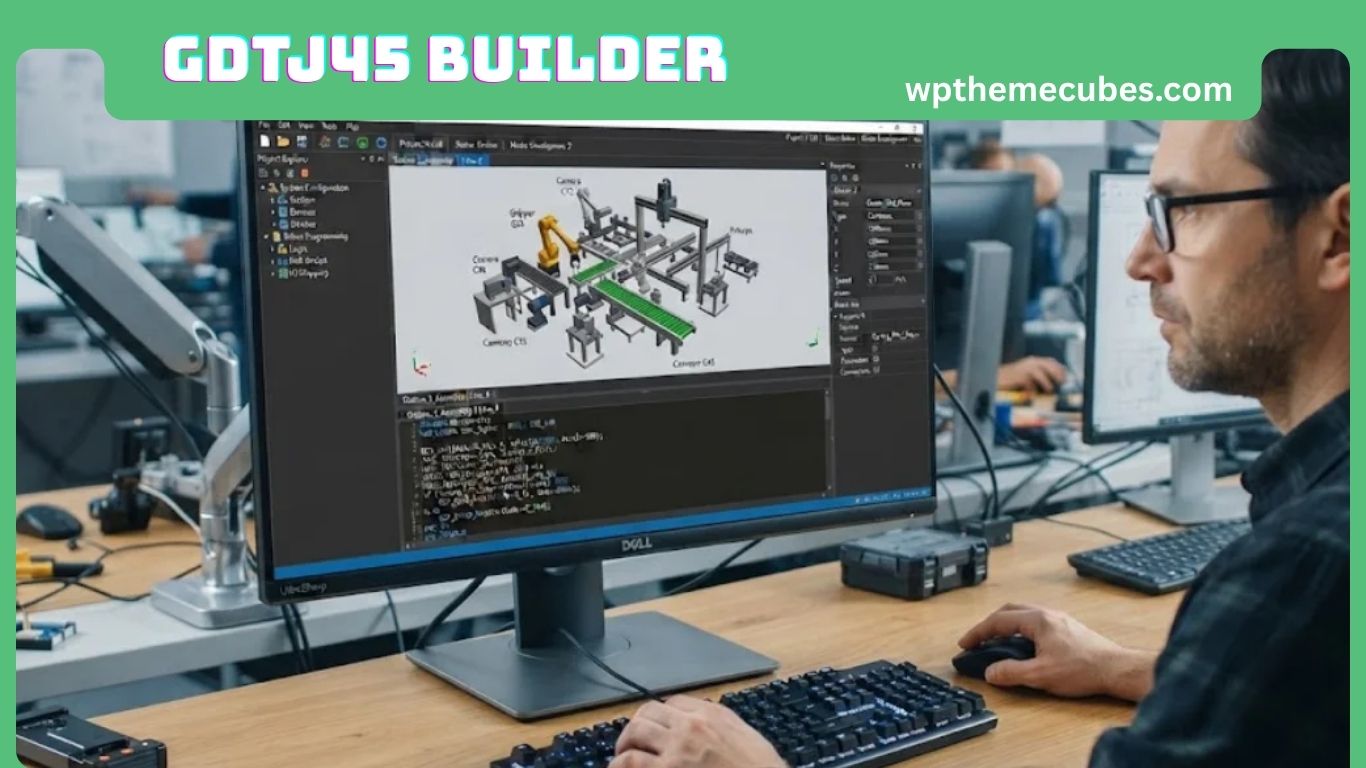
GDTJ45 Builder: Complete Guide to the Software
GDTJ45 Builder is a technology term that has attracted growing attention in 2026. It is commonly described online as a modular development platform that combines visual building tools with custom coding. The idea behind this type of platform is simple: developers can create parts of an application visually, reuse existing components, and still access code when they need more control.
However, there is an important detail that anyone researching gdtj45 builder should understand before relying on information found online. Public descriptions of the product are highly inconsistent. Some websites describe it as a modern development platform, while other sources question whether a formally established software product exists under this exact name. Some articles also repeat precise user numbers, performance statistics, programming-language support, and technical capabilities without providing primary documentation.
That makes careful evaluation especially important.
This guide explains what gdtj45 builder is reported to be, how the builder concept works, its potential features, possible applications, advantages and limitations, security considerations, alternatives, and how users can verify software claims before adopting an unfamiliar development platform.
What Is GDTJ45 Builder?
GDTJ45 Builder is generally described in 2026 online material as a modular software development environment designed to combine visual development with direct code customization.
The term “builder” suggests an environment where users do not have to create every part of a project from an empty file. Instead, a developer may work with reusable components, workflows, interfaces, templates, or logic modules and then customize those components through code.
This concept is not unusual in modern software development. Many established platforms use some form of visual development, low-code functionality, reusable components, or code-assisted workflows.
What makes the gdtj45 builder keyword interesting is the way different online sources describe it. Some characterize it as a hybrid low-code and pro-code platform. Others describe it as a general development or build system. Still others question whether the product has a verifiable commercial identity.
Therefore, it is more accurate to describe GDTJ45 Builder as a reported or emerging software concept rather than make unsupported claims about a fully established product.
The distinction matters for developers, businesses, and students. Before installing unknown software, users should look for official documentation, a verified developer or company, release information, security documentation, and a legitimate distribution channel.
A good development platform should be easy to verify.

How GDTJ45 Builder Is Reported to Work
The general concept associated with gdtj45 builder software is modular development.
Modular development means dividing a large software project into smaller pieces. Each piece performs a particular function and can potentially be reused in another part of the application.
For example, a project could contain separate modules for:
- User authentication
- Database access
- API communication
- Navigation
- User interfaces
- Form validation
- Notifications
- Reporting
- Testing
- Deployment
Instead of rebuilding these functions repeatedly, developers can organize them as reusable components.
A visual builder can make this process easier by allowing users to arrange components through an interface. A code editor can then provide deeper control when a visual configuration is not enough.
This creates a hybrid workflow.
Also Read:Google Ads for Doctors SEO Outline: Complete Guide
A beginner may start with visual components while an experienced developer can move into source-level customization. In theory, this reduces the gap between low-code development and traditional programming.
However, the exact implementation of these capabilities in GDTJ45 Builder has not been consistently documented through authoritative primary sources. That is why users should distinguish between the general technology concept and specific claims about the product.
Why Modular Development Matters
Modularity is one of the most useful ideas in modern software engineering.
Large applications can become difficult to maintain when every feature is tightly connected to every other feature. A small change can unexpectedly affect unrelated parts of the application.
Modular architecture attempts to reduce this problem.
Suppose a company creates an internal employee portal. The application may need login functionality, employee records, reporting, notifications, and administrative controls.
With a modular approach, each major function can be separated.
If the notification system needs to change, developers can work primarily on the notification module instead of changing the entire application.
This approach can provide several benefits:
- Easier maintenance
- Better organization
- Greater code reuse
- Simpler testing
- Easier troubleshooting
- More flexible development
- Better separation of responsibilities
The reported modular nature of gdtj45 builder software fits this broader development philosophy.
But modularity alone does not automatically make software better. Poorly designed modules can still create technical debt. Good architecture requires clear interfaces, documentation, testing, version control, and consistent coding practices.
Visual Building and Custom Code
One of the most frequently reported ideas associated with gdtj45 builder is the combination of visual development and custom coding.
Visual development can be useful because it gives users a direct representation of application structure.
Instead of immediately writing code, a developer might first arrange components on a visual canvas. This can make workflows easier to understand, especially during early prototyping.
Custom code becomes useful when the visual system reaches its limits.
For example, a visual builder might make it easy to create a form, but a developer may need custom logic for an unusual validation rule. A visual workflow might handle a standard API request, but an application could require specialized authentication or data processing.
A hybrid approach attempts to provide both levels of control.
This is an important distinction between a genuine pro-code environment and a basic template builder. Developers generally need the ability to inspect, modify, test, and maintain what the builder produces.
If users cannot access the underlying logic, they can become dependent on the platform.
For professional projects, code ownership and portability should therefore be considered before adopting any builder.
Reported Features of GDTJ45 Builder
Online descriptions of gdtj45 builder software mention several capabilities. Because these features are not consistently supported by authoritative product documentation, they should be treated as reported characteristics rather than guaranteed specifications.
The most common descriptions include modular project architecture, visual development, custom code editing, reusable components, integration capabilities, collaboration, testing, and deployment support.
A modular architecture would allow developers to organize projects into reusable building blocks.
A visual interface could help users design application structures without manually creating every element.
A code editor could provide access to more advanced customization.
Integration features, if available, would be useful for connecting applications with databases, APIs, authentication systems, and external services.
Collaboration features could help teams work on shared projects.
Testing and debugging tools would be important for identifying problems before deployment.
Cloud or deployment functionality could potentially simplify the process of moving applications from development into production.
The key point is that these capabilities describe the type of platform discussed in online material. They should not be interpreted as verified product specifications unless supported by official documentation.
GDTJ45 Builder for Developers
Professional developers generally care about control, maintainability, compatibility, and workflow efficiency.
A builder platform can be valuable when it reduces repetitive work without preventing developers from accessing the underlying system.
For example, a developer creating several internal applications may benefit from reusable components. Instead of rebuilding authentication, navigation, forms, and standard data operations for every project, common elements could be standardized.
This can improve consistency across applications.
However, experienced developers should also ask harder questions.
Can the generated code be exported?
Can developers use Git-based version control?
Can applications run outside the platform?
How are dependencies managed?
What programming languages are supported?
How are security updates handled?
Can the system integrate with existing infrastructure?
What happens if the vendor stops maintaining the product?
These questions are often more important than the number of visual components available.
A visually impressive builder can still become a problem if it creates vendor lock-in or produces difficult-to-maintain code.
GDTJ45 Builder for Startups and Small Businesses
Startups often need to build products quickly while working with limited resources.
A modular builder can theoretically help startups create prototypes, internal tools, dashboards, customer portals, and early product versions without building every feature from scratch.
This can be especially useful during the validation stage.
For example, a startup may want to test whether customers actually need a particular workflow before investing heavily in a custom engineering system.
A builder can potentially shorten the time between an idea and a working prototype.
But startups should avoid confusing speed with long-term scalability.
A prototype that works for 100 users may not work for 100,000 users. A system designed for internal testing may not satisfy enterprise security requirements.
For that reason, startups should create a technology exit strategy.
If the project becomes successful, can it be migrated to a traditional development environment?
If the builder becomes unavailable, can the source code and data be recovered?
If the answers are unclear, the platform should be used carefully.
GDTJ45 Builder for Rapid Prototyping
Rapid prototyping is one of the strongest potential use cases for builder-style software.
A prototype does not need to be a complete production application. Its purpose is to test an idea.
A product team may need to determine whether users understand a new workflow. A designer may want to test navigation. A business owner may need a working demonstration for investors.
A visual development environment can make these experiments faster.
The important advantage is not simply drag-and-drop functionality. The real advantage is reducing the amount of time spent on repetitive setup.
A good prototype should answer a business or product question.
For example:
Will customers use this feature?
Does the workflow make sense?
Can employees complete the task without training?
Does the proposed interface reduce unnecessary steps?
This is where builder technology can provide meaningful value.
However, teams should clearly label prototypes as prototypes. Temporary shortcuts should not quietly become permanent production architecture.
GDTJ45 Builder and API Integration
Modern applications rarely operate alone.
Websites and applications often communicate with payment services, customer relationship systems, databases, analytics platforms, authentication providers, messaging systems, and other APIs.
A development builder can become more useful when it simplifies these connections.
An API integration generally involves sending or receiving structured information between systems.
For example, an application might send customer information to a CRM after a form is submitted.
A builder could potentially make this process easier through visual configuration while still allowing custom code for advanced requirements.
But integrations are also a major security concern.
API keys should never be exposed in client-side code when they are intended to remain private. Authentication tokens need appropriate protection. Requests should be validated. External services should use secure connections.
Developers should therefore evaluate how an unfamiliar builder handles secrets, credentials, permissions, logging, and API authentication before connecting business systems.
GDTJ45 Builder and Code Editing
The ability to edit code is important for users who want more than a simple no-code platform.
Code editing provides developers with greater flexibility.
If a visual component does not support a particular requirement, custom code may provide a solution. Developers can also use code to optimize performance, implement specialized logic, or connect systems that are not supported visually.
However, code editing alone does not guarantee professional development quality.
A useful environment should ideally provide features such as syntax assistance, error detection, debugging, testing, version control, dependency management, and documentation.
The exact code-editing capabilities attributed to GDTJ45 Builder vary between online sources. Some pages make specific claims about programming-language support, but those claims should be verified through primary documentation before being used for an actual project.
For developers considering the platform, the safest approach is to test a small non-sensitive project first.
Security and Privacy Considerations
Security should be one of the first questions when evaluating any development software.
This is especially true when a platform handles source code, credentials, customer information, financial data, or proprietary business logic.
Before using an unfamiliar builder, check whether there is clear information about:
- Data storage
- Encryption
- Authentication
- Access controls
- Account recovery
- Security updates
- Vulnerability reporting
- Privacy practices
- Data deletion
- Backup procedures
- Third-party integrations
Do not assume that a platform is secure simply because an article describes it as “enterprise-grade.”
Security claims should come from documentation or other credible evidence.
Also Read:Priority Infrastructure Plan: How Projects Are Ranked and Funded
Users should also download software only from trusted sources. Unknown executable files can create unnecessary security risks.
If a website offers an unfamiliar GDTJ45 Builder installer but does not clearly identify the developer, version, documentation, or source, caution is appropriate.
For organizations, software approval should include security and IT review rather than relying solely on an online article.
Is GDTJ45 Builder Real or Fake?
This is one of the most important questions surrounding the keyword.
There are online articles that describe GDTJ45 Builder as an emerging modular development platform. Other publications explicitly question whether it is a real, independently verifiable software product. One 2026 source states that it could not verify a commercial product, open-source project, or established software listing under the GDTJ45 name.
At the same time, multiple websites publish detailed descriptions claiming that GDTJ45 Builder emerged in 2026 and combines visual development with custom coding.
This creates a credibility problem.
There is a major difference between “many websites describe a product” and “a product has been independently verified.”
Repeated information does not automatically become true.
For example, several websites repeat claims involving millions of users, code-processing volumes, development speed improvements, and specific programming languages. Yet other sources point out that these claims lack reliable primary evidence.
Therefore, the most responsible conclusion in 2026 is that the GDTJ45 Builder name has a substantial online footprint, but its exact product identity, official documentation, ownership, and independently verifiable specifications remain unclear.
Anyone considering using it should verify the source before installing or purchasing anything.
Common GDTJ45 Builder Problems and Why They Matter
Search results also contain phrases such as “software GDTJ45 builder does not work” and “GDTJ45 builder software problems.”
These searches may represent several different situations.
A user may have encountered the term in an article and expected to find a downloadable application.
Another possibility is that the term appeared in a generated document, code example, advertisement, or website.
A third possibility is that someone has mistaken the name for an existing development tool.
This is why troubleshooting should begin with verification.
Before trying to fix an installation problem, determine whether there is actually a legitimate installation package from an identifiable software publisher.
If there is no verified publisher or official documentation, downloading random “fixes” can make the situation worse.
Security researchers and IT professionals generally recommend treating unfamiliar downloads carefully, particularly executable files from unknown websites.
The safest troubleshooting process is therefore:
First, verify the product identity.
Second, locate official documentation.
Third, confirm the publisher.
Fourth, confirm the software version.
Fifth, scan downloaded files using trusted security software.
Sixth, avoid entering passwords or sensitive information into unknown applications.
This approach is safer than searching for unofficial patches.
How to Evaluate GDTJ45 Builder Before Using It
If you are interested in gdtj45 builder, use a verification checklist before committing to it.
Start with the official source.
A legitimate software product should normally have a clearly identifiable publisher, documentation, version history, support information, and a reliable distribution method.
Next, check independent evidence.
Look for credible software directories, developer communities, technical documentation, public repositories, release announcements, or other sources that can confirm the product independently.
Then examine the technical details.
Ask whether the platform supports the languages and frameworks your team actually uses.
Check whether generated code can be exported.
Review how data is stored.
Understand pricing and licensing.
Look at support options.
Test performance with a small project.
Finally, consider portability.
The best development tool is not necessarily the one with the most features. It is the one that solves the current problem without creating a larger problem later.
GDTJ45 Builder vs. Traditional Development
Traditional development normally gives developers extensive control.
A developer can select the programming language, framework, database, hosting provider, architecture, testing system, and deployment process.
This flexibility comes with a cost.
Projects can require more development time, more technical knowledge, and more maintenance.
Builder platforms attempt to simplify some of these tasks.
The trade-off is control.
A builder may allow a team to move faster at the beginning but impose limitations later.
This creates an important decision.
If the project is small, temporary, or experimental, a builder may provide strong practical value.
If the application is highly specialized, security-sensitive, or expected to operate for many years, traditional development may provide greater control.
Hybrid development can sit between the two.
Teams can use visual tools for repetitive tasks while maintaining traditional code for specialized functionality.
That is arguably the most valuable idea behind the gdtj45 builder concept.
GDTJ45 Builder Alternatives
If you are researching GDTJ45 Builder because you want a platform that combines visual development with professional customization, established alternatives may be easier to evaluate.
Webflow and Framer are widely associated with visual web development.
Bubble is known for visual application development.
Retool focuses heavily on internal business applications.
Appsmith is an open-source-oriented platform for building internal tools.
Figma is primarily a design and prototyping platform rather than a complete application builder, but it can play an important role in a modern product workflow.
Traditional development environments such as Visual Studio Code provide much deeper direct coding control.
The right choice depends on what you are building.
For a website, a visual web platform may be appropriate.
For an internal dashboard, an internal-tool builder may be more efficient.
For a highly customized software product, a conventional development stack may be the better long-term choice.
The goal should not be to find the platform with the most impressive marketing language. The goal is to find a verified tool that matches the project’s requirements.
What the GDTJ45 Builder Trend Tells Us About Software Development
Even if the exact status of GDTJ45 Builder remains uncertain, the broader idea behind the keyword reflects a real direction in software development.
Teams increasingly want tools that reduce repetitive work without removing developer control.
The old distinction between “no-code” and “traditional coding” is becoming less useful.
Modern development often combines multiple approaches.
A designer may use a visual interface.
Also Read:Provascin: Ingredients, Cardiovascular Support, and Safety
An AI assistant may generate an initial piece of code.
A developer may review and modify that code.
Automated testing may check the result.
A deployment system may then publish the application.
This is a workflow rather than a single tool.
The strongest insight is that productivity comes from connecting these stages effectively.
A builder is useful when it removes unnecessary work while keeping developers responsible for architecture, testing, security, and quality.
That principle applies whether GDTJ45 Builder becomes a verified mainstream product or simply remains a widely searched technology term.
Conclusion
GDTJ45 Builder is currently an unusual technology keyword because online descriptions are much more confident than the available independent verification.
Several 2026 articles describe it as a modular development platform that combines visual design with custom coding, reusable components, integrations, and collaborative development.
However, other investigations have found no reliable evidence of a formally established software product under the GDTJ45 name and have highlighted contradictory claims across websites.
For that reason, users should not treat every feature list, performance statistic, user count, or installation guide online as confirmed fact.
The best approach is verification first.
If you encounter a legitimate GDTJ45 Builder product with an identifiable publisher, official documentation, transparent licensing, security information, and a trustworthy download channel, those details can be evaluated on their own merits.
Until then, the safest interpretation is that gdtj45 builder represents a reported 2026 software-development concept whose public identity and specifications require additional verification.
For developers, the broader lesson is valuable: choose technology based on evidence, maintainability, security, portability, and actual project requirements rather than search-engine popularity alone.
Frequently Asked Questions About GDTJ45 Builder
1. What does the name GDTJ45 Builder mean?
There is no universally documented explanation for the GDTJ45 name. Online articles use it to describe a reported development or builder platform, but the origin of the identifier has not been consistently established through authoritative documentation.
2. Is GDTJ45 Builder suitable for beginners?
The reported visual-builder concept could make software development easier for beginners because visual components can reduce the amount of code needed at the beginning. However, users should first verify that they are dealing with a legitimate and supported product before learning the platform.
3. Can GDTJ45 Builder replace professional developers?
A builder cannot automatically replace professional software engineering. Visual tools can reduce repetitive work, but developers are still needed for architecture, security, testing, integrations, performance, debugging, and long-term maintenance.
4. Should businesses download GDTJ45 Builder from third-party websites?
Businesses should avoid downloading unknown software simply because a third-party article recommends it. The publisher, official distribution channel, software signature, documentation, licensing, and security information should be verified first.
5. Why are there so many different descriptions of GDTJ45 Builder?
The keyword has appeared across numerous websites with noticeably different descriptions. Some sources describe it as a modular development platform, while others question whether a verifiable product exists. This inconsistency is a reason to evaluate primary evidence instead of relying on repeated online claims.