Geometry Learn V3: The Complete 2026 Guide to Interactive Geometry Learning
Geometry is much more than shapes, angles, and formulas. It helps people understand the world around them, develop logical thinking, and solve real-life problems. Modern educational technology has made geometry easier to learn than ever before. One platform that has gained attention is geometry learn v3.
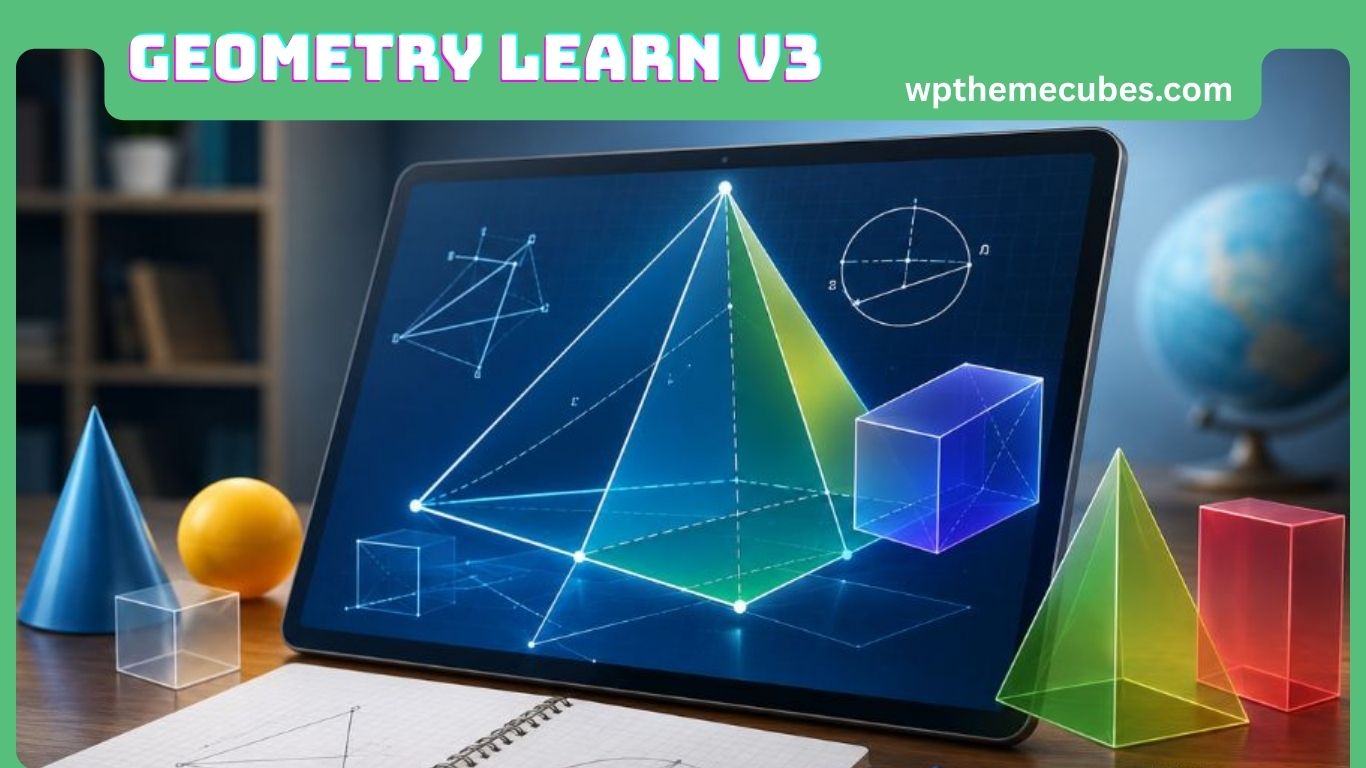
Geometry learn v3 is an advanced browser-based educational platform designed to teach spatial mathematics through interactive learning. Instead of relying only on textbooks, students can explore shapes, build geometric figures, test ideas, and visualize mathematical concepts directly in their web browser.
Whether you are a student preparing for exams, a teacher searching for classroom resources, or a parent helping a child learn mathematics, geometry learn v3 offers a modern learning experience that combines education with hands-on practice.
This comprehensive guide explains everything you need to know about geometry learn v3, including its features, educational value, benefits, practical uses, learning strategies, and future potential.
What Is Geometry Learn V3?
Geometry learn v3 is an interactive online geometry learning platform that focuses on visual and practical mathematics education. Since it works directly inside a web browser, users do not need to install complicated software before getting started.
The platform allows learners to create geometric constructions, manipulate shapes, measure angles, examine relationships, and better understand mathematical concepts through experimentation.
Unlike traditional learning methods where students memorize formulas first, geometry learn v3 encourages discovery. Students can observe how changing one element affects an entire figure, making geometry easier to understand.
Its browser-based design also means students can access lessons from laptops, desktops, Chromebooks, and many tablets with internet access.
Why Geometry Learn V3 Is Becoming Popular
Many students struggle with geometry because diagrams in textbooks remain static. They cannot move lines, rotate shapes, or test mathematical ideas.
Geometry learn v3 solves this challenge by making every lesson interactive.
Instead of simply reading about triangles, circles, or polygons, learners can manipulate them in real time.
Several factors have contributed to its growing popularity:
- Interactive learning experience
- Browser-based accessibility
- Easy-to-use interface
- Strong visual learning approach
- Suitable for different education levels
- Helpful for both classroom and independent study
- Supports active problem-solving instead of passive memorization
These advantages make geometry learn v3 appealing to modern educators and students alike.
How Geometry Learn V3 Works
Geometry learn v3 uses interactive mathematical tools that allow users to construct geometric objects directly on a digital workspace.
Users typically begin with simple tools such as:
- Point creation
- Line drawing
- Segment construction
- Angle measurement
- Circle creation
- Polygon building
As learners become more comfortable, they can create increasingly complex geometric constructions while exploring mathematical relationships.
Because every object remains dynamic, users can drag points and immediately observe how measurements change.
This interactive approach helps students understand concepts instead of memorizing isolated formulas.
Main Features of Geometry Learn V3
Geometry learn v3 includes numerous educational tools designed to improve geometry learning.
Also Read:The Flying Elephant Memoirs of an Olympic Champion Kindle Edition: Complete Guide & Honest Review
Interactive Geometry Workspace
The central workspace acts as a virtual drawing board where students create and manipulate geometric figures.
Instead of looking at printed images, learners interact directly with mathematical objects.
Dynamic Shape Manipulation
Users can move vertices, rotate figures, resize polygons, and instantly observe mathematical changes.
Dynamic movement strengthens conceptual understanding.
Angle Measurement Tools
Students can measure:
- Interior angles
- Exterior angles
- Complementary angles
- Supplementary angles
Real-time measurements reinforce classroom lessons.
Distance and Length Measurement
Geometry learn v3 allows users to calculate:
- Line segments
- Side lengths
- Perimeters
- Radius
- Diameter
Measurements update automatically whenever objects change.
Construction Tools
Students can construct:
- Perpendicular bisectors
- Angle bisectors
- Parallel lines
- Tangent lines
- Midpoints
- Circles
These tools make classical geometry easier to practice.
Browser-Based Learning
One of the biggest strengths of geometry learn v3 is that it works inside modern web browsers.
This eliminates installation problems while making learning accessible from almost anywhere.
Visual Learning Environment
Many students learn better visually than through text alone.
Geometry learn v3 transforms abstract mathematical concepts into visual experiences.
Educational Philosophy Behind Geometry Learn V3
The platform reflects an important educational shift.
Instead of asking students to memorize procedures first, it encourages exploration before formal instruction.
Students become active participants rather than passive readers.
This learning philosophy supports:
- Curiosity
- Critical thinking
- Independent reasoning
- Experimentation
- Problem-solving
- Visual understanding
Research in mathematics education consistently shows that active engagement improves long-term retention compared to memorization alone.
Benefits for Students
Geometry learn v3 offers many educational advantages.
Better Conceptual Understanding
Students can actually see mathematical relationships instead of imagining them.
Visualization reduces confusion.
Improved Problem-Solving Skills
Interactive exploration encourages learners to test hypotheses and discover patterns independently.
Increased Confidence
When students manipulate objects themselves, difficult concepts become easier to understand.
This builds confidence in mathematics.
Flexible Learning Pace
Every learner progresses differently.
Geometry learn v3 allows students to practice as much as necessary.
Reduced Math Anxiety
Many learners find geometry intimidating.
Interactive learning often feels less stressful than traditional worksheets.
Benefits for Teachers
Teachers also gain significant advantages.
Geometry learn v3 can support:
- Classroom demonstrations
- Interactive lessons
- Homework assignments
- Group activities
- Online learning
- Hybrid education
- Student exploration
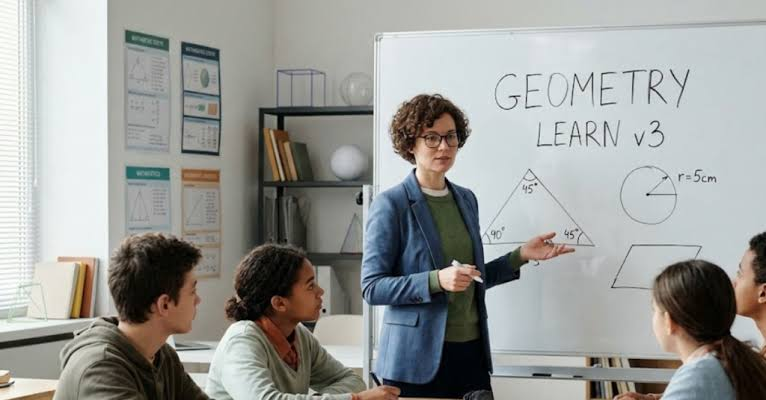
Instead of drawing diagrams repeatedly on a whiteboard, teachers can demonstrate concepts dynamically.
Students immediately see how changes affect geometric figures.
Benefits for Parents
Parents helping children with homework may not remember every geometry rule.
Geometry learn v3 simplifies learning through visualization.
Parents can observe concepts alongside their children without requiring advanced mathematical expertise.
This creates better home learning experiences.
Topics Students Can Learn with Geometry Learn V3
Geometry learn v3 supports many essential geometry concepts.
These commonly include:
Basic Geometry
Students learn:
- Points
- Lines
- Rays
- Segments
- Planes
These concepts provide the foundation for future mathematics.
Angles
Students explore:
- Acute angles
- Right angles
- Obtuse angles
- Straight angles
- Reflex angles
Interactive measurement improves understanding.
Triangles
Learners study:
- Equilateral triangles
- Isosceles triangles
- Scalene triangles
- Right triangles
They also investigate angle relationships and side properties.
Quadrilaterals
Students compare:
- Squares
- Rectangles
- Rhombuses
- Parallelograms
- Trapezoids
Interactive movement highlights similarities and differences.
Circles
Geometry learn v3 helps learners understand:
- Radius
- Diameter
- Circumference
- Chords
- Arcs
- Tangents
- Sectors
Visual exploration makes these concepts easier.
Polygons
Students investigate:
- Pentagons
- Hexagons
- Heptagons
- Octagons
- Regular polygons
- Irregular polygons
Coordinate Geometry
Many geometry platforms include graphing features that combine geometry with algebra.
Students learn about:
- Coordinates
- Slopes
- Distance formulas
- Midpoints
Why Interactive Geometry Is More Effective Than Static Textbooks
Traditional textbooks present fixed diagrams.
Students cannot modify them.
Also Read:Business Intelligence Exercises: 10 Hands-On Projects for Beginners and Professionals
Interactive geometry changes this completely.
With geometry learn v3, users can:
- Move vertices
- Test different constructions
- Compare shapes
- Explore symmetry
- Investigate mathematical rules
Learning becomes an active process instead of passive reading.
Real-World Applications of Geometry
One reason geometry matters is its practical value.
Geometry appears in many industries.
Architecture
Architects use geometric principles to design buildings.
Engineering
Engineers rely on geometry for structures, machinery, bridges, and transportation systems.
Computer Graphics
Video games, animation, and digital design all depend heavily on geometric mathematics.
Robotics
Robot movement often requires spatial calculations.
Manufacturing
Factories use geometry for precision production.
Navigation
Maps, GPS systems, and surveying depend on geometric calculations.
Understanding these applications helps students appreciate why geometry matters beyond school.
Learning Tips for Success with Geometry Learn V3
Students can maximize learning by following several strategies.
Start with simple constructions before attempting advanced projects.
Practice consistently rather than studying only before exams.
Experiment freely by moving shapes and observing changes.
Try solving problems independently before checking answers.
Review concepts regularly.
Apply geometry to real-world situations whenever possible.
These habits build deeper understanding over time.
Common Challenges Students Face
Even with interactive tools, students may encounter obstacles.
Some common challenges include:
Confusing similar geometric terms.
Mixing up angle relationships.
Difficulty visualizing three-dimensional objects.
Misunderstanding geometric proofs.
Rushing through constructions.
Fortunately, geometry learn v3 encourages experimentation, making it easier to identify and correct mistakes.
Geometry Learn V3 for Remote Learning
Online education continues to expand.
Browser-based educational platforms have become especially valuable.
Geometry learn v3 fits remote learning because students only need internet access and a compatible browser.
Teachers can demonstrate lessons during virtual classes while students follow along from home.
Assignments can become more interactive than traditional worksheets.
Geometry Learn V3 and Visual Learning
Visual learners often understand mathematics better when concepts become graphical.
Instead of memorizing abstract definitions, they observe mathematical relationships directly.
Geometry learn v3 supports visual thinking by allowing learners to manipulate objects in real time.
This approach often improves memory retention.
Geometry Learn V3 Compared with Traditional Geometry Learning
Traditional geometry education generally focuses on:
- Reading textbooks
- Copying diagrams
- Memorizing formulas
- Solving paper exercises
Geometry learn v3 expands learning by including:
- Interactive exploration
- Immediate feedback
- Dynamic constructions
- Visual experimentation
- Hands-on discovery
Both approaches remain valuable, but combining them often produces better educational outcomes.
How Geometry Learn V3 Supports Different Learning Styles
Every student learns differently.
Geometry learn v3 accommodates multiple learning preferences.
Visual learners benefit from diagrams.
Kinesthetic learners enjoy manipulating objects.
Logical learners appreciate discovering mathematical relationships.
Independent learners can practice at their own pace.
Collaborative learners can discuss constructions with classmates.
Supporting multiple learning styles increases accessibility.
Best Practices for Teachers Using Geometry Learn V3
Teachers can improve classroom engagement by:
Beginning lessons with interactive demonstrations.
Allowing students to explore before introducing formulas.
Encouraging group discussions about observations.
Assigning creative geometry projects.
Using real-life examples whenever possible.
Balancing digital activities with written problem-solving.
These methods help students connect theory with practical understanding.
Future of Browser-Based Geometry Education
Educational technology continues evolving rapidly.
Future versions of browser-based geometry platforms may include:
Artificial intelligence tutoring.
Personalized learning recommendations.
Automatic mistake detection.
Voice-guided instruction.
Augmented reality visualization.
Virtual reality geometry exploration.
Collaborative online classrooms.
Although geometry learn v3 already provides an engaging experience, continued innovation will likely make interactive mathematics even more effective.
Expert Insights on Geometry Learn V3
From an educational perspective, the greatest strength of geometry learn v3 is not simply its digital interface but its ability to transform abstract mathematics into observable experiences.
Many students struggle because geometry often feels disconnected from reality. When learners can drag a triangle’s vertex and instantly watch angles and side lengths change, mathematical relationships become meaningful instead of mysterious.
Another important advantage is that interactive platforms encourage exploration. Rather than fearing mistakes, students experiment, discover patterns, and build confidence. This mirrors how mathematicians and scientists solve problems in the real world.
Teachers can also shift from lecture-heavy instruction to inquiry-based learning, where students actively investigate concepts before formal explanations are introduced. This approach often leads to stronger understanding and longer-lasting knowledge.
Common Mistakes to Avoid While Learning Geometry
Even with advanced educational platforms, students should avoid several common mistakes.
Skipping foundational concepts before moving to advanced topics.
Memorizing formulas without understanding why they work.
Ignoring geometric definitions.
Rushing through constructions.
Failing to verify measurements.
Practicing only before exams.
Not reviewing mistakes.
Also Read:Technology Solutions Professional: Roles, Skills, Education, and Career Opportunities
Avoiding challenging problems.
Taking time to understand each concept thoroughly produces better long-term results than simply completing assignments quickly.
Is Geometry Learn V3 Worth Using?
For students who prefer visual learning, geometry learn v3 offers significant educational value.
Its browser-based design removes installation barriers, while interactive tools make complex geometry concepts easier to understand.
Teachers benefit from engaging demonstrations.
Parents gain an accessible resource for supporting homework.
Students receive opportunities to explore mathematics rather than merely memorize it.
Although no single platform can replace quality teaching, geometry learn v3 works well as a learning companion that reinforces classroom instruction through practical experience.
Final Thoughts
Geometry continues to play an essential role in education, science, engineering, architecture, technology, and everyday life. Understanding geometric principles builds logical reasoning, spatial awareness, and analytical thinking that extend far beyond mathematics classrooms.
Geometry learn v3 represents the modern direction of math education by combining browser-based accessibility with interactive exploration. Instead of simply reading definitions, students engage directly with mathematical ideas, making learning more enjoyable, memorable, and effective.
As digital education continues to grow, platforms like geometry learn v3 demonstrate how technology can improve conceptual understanding while encouraging curiosity and independent thinking. Whether you are a beginner learning basic shapes or an advanced student exploring complex constructions, interactive geometry provides a practical path toward stronger mathematical skills.
Frequently Asked Questions
What makes geometry learn v3 different from ordinary geometry websites?
Geometry learn v3 focuses on interactive exploration instead of only providing text lessons. Users can build, modify, and analyze geometric figures in real time.
Can beginners use geometry learn v3?
Yes. Beginners can start with basic concepts such as points, lines, and angles before progressing to more advanced geometric constructions.
Does geometry learn v3 require software installation?
No. It is designed as a browser-based platform, allowing users to access learning tools without installing traditional desktop software.
Is geometry learn v3 suitable for homeschooling?
Yes. Many homeschool families can use interactive geometry platforms to supplement textbooks and create a more engaging learning experience.
Can geometry learn v3 improve spatial reasoning?
Yes. Regular interaction with shapes, measurements, and geometric constructions helps strengthen spatial visualization and reasoning skills over time.
Is geometry learn v3 appropriate for classroom teaching?
Absolutely. Teachers can use it for demonstrations, student activities, collaborative exercises, and interactive lessons that encourage active participation.
Can students use geometry learn v3 for exam preparation?
Yes. It can reinforce geometry concepts learned in school and provide additional hands-on practice before quizzes, standardized tests, and final exams.
Does geometry learn v3 help students understand geometric proofs?
Interactive constructions can help students visualize why many geometric relationships are true, making formal proofs easier to understand.